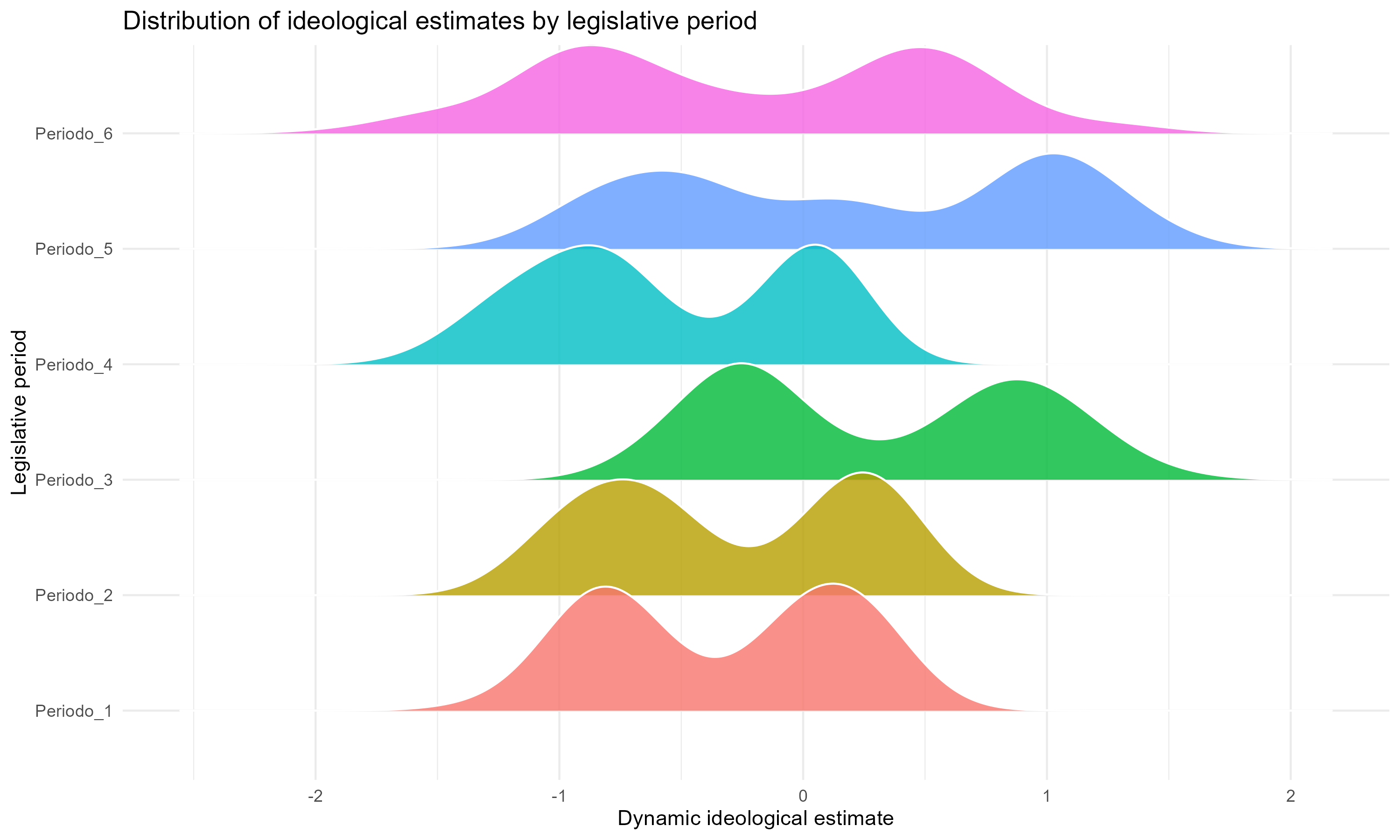
This dataset provides ideological position estimates for members of the Chilean Chamber of Deputies across six consecutive legislative periods, spanning from 2002 to 2026 in four-year intervals. The estimates are based exclusively on roll-call votes related to bill proposals debated and voted on in the plenary sessions. It excludes other types of votes, such as those on non-binding agreements or investigative commissions, which do not directly contribute to lawmaking.
Methodology
To estimate ideological positions, the dataset includes results from three distinct methods:
- DW-NOMINATE: Uses the classic model, primarily for comparative purposes.
- Bayesian Model: Applies a Bayesian model to estimate latent ideological positions within each legislative period.
- Dynamic Model: Introduces a dynamic model suitable for large scale data that links estimates across time, allowing direct comparisons of ideological positions even when legislators served in different periods.
Each methodological approach offers a different lens to examine ideological variation and change within the Chilean legislature. The dynamic model, in particular, supports longitudinal research by enabling consistent ideological comparisons across more than two decades.
Dataset Content
In addition to ideological estimates, the dataset includes information on each deputy’s party affiliations throughout their time in office, as well as their age and date of birth.
The period covered is marked by institutional reforms and broader political shifts, including a major electoral reform enacted during the middle of this time frame that increased the number of deputies from 120 to 155. As a result, earlier periods contain fewer legislators than later ones—a structural change that enhances the dataset’s value for studying institutional evolution and its effects on legislative dynamics.
Researchers can use this dataset to explore topics such as:
- Political polarization
- Coalition dynamics
- Party-system development
- The relationship between institutional reforms and representation
The structure and transparency of the dataset make it suitable for integration with other legislative or electoral databases, offering additional opportunities for analysis in political science, public policy, and institutional studies.
Data Access and Publication
The complete dataset, including roll-call vote files and ideological estimates, is available in the Harvard Dataverse repository: https://doi.org/10.7910/DVN/FOXOIT
The associated methodological article is published in Data in Brief: https://doi.org/10.1016/j.dib.2025.112163
Suggested citation: Fábrega, J. (2025). Ideological positions in the chilean chamber of deputies (2002–2026): A legislative roll-call dataset.
Funding: This work was funded by FONDECYT Regular Grant No. 1231131.