This project extends foundational research on the diffusion of innovations by re-examining the celebrated Korean Family Planning (KFP) dataset. Beyond the initial adoption of modern contraceptives, this work investigates the social dynamics of disadoption, understood as the decision to cease using a modern method. The work is being developed by Aníbal Olivera in collaboration with Thomas Valente, a world reference in the study of networks and health.
The analysis was carried out in three main stages to ensure rigor and build upon established findings. The first step involved reconstructing time-stamped adoption data from the original KFP survey variables. This new data object successfully replicated the key adoption models presented in Valente’s (2010) book, Social Networks and Health, confirming the validity of the underlying data structure.
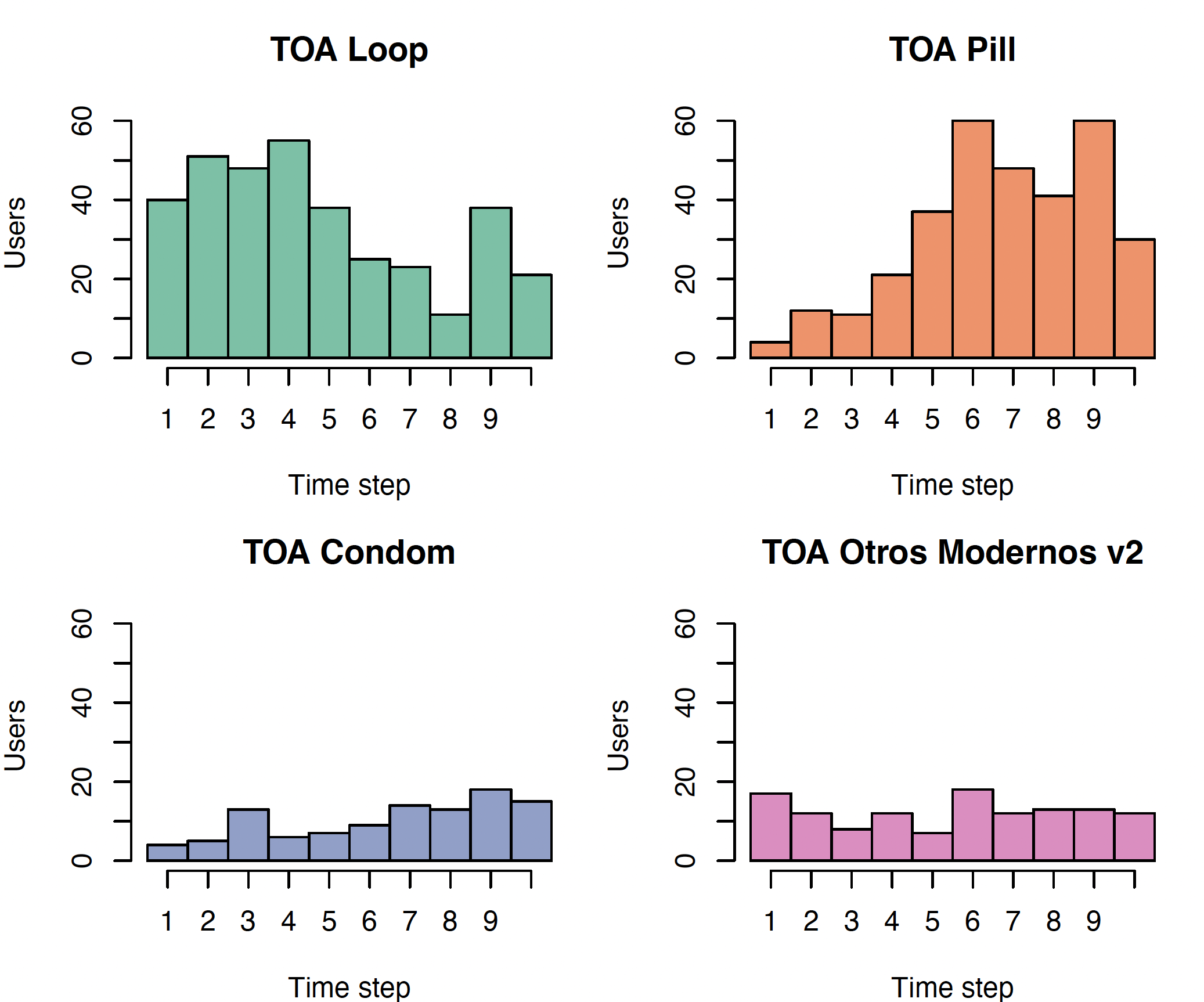
Subsequently, a novel metric called the “disadoption gap” was developed. This variable measures the difference between an individual’s peak past exposure to adopting neighbors and their current exposure. Formally, we define cohesion exposure (lagged by one period) as the share of ego $i$’s alters in Modern use:
$$ E_i(t) = \frac{\sum_j A_{ij}(t) M_{j,t-1}}{\sum_j A_{ij}(t)} $$We track the within-ego running maximum $E_i^{\max}(t) = \max_{u \le t} E_i(u)$ and define the disadoption gap as:
$$ E_i^D(t) = E_i^{\max}(t) - E_i(t) \in [0, 1] $$The intuition is that when neighbors who had been modern stop being modern, $E_i(t)$ falls below its past peak and $E_i^D(t)$ rises.
The study employed discrete-time hazard models to analyze the probability of stable disadoption, including village and period fixed effects to control for unobserved environmental and temporal factors. The logit model specification is as follows:
$$ \text{logit} \Pr\{Y_{it} = 1 \mid \mathcal{F}_{t-1}\} = \alpha_t + \beta_D E_i^D(t) + \beta_E E_i(t) + \mathbf{\gamma}_{\text{deg}}^\top \mathbf{d}_{it} + \delta \text{CumDisadopt}_{g(i)}(t) + \dots + \eta_{g(i)} $$where $\eta_{g(i)}$ are village fixed effects and the vector of controls includes individual characteristics such as age, number of children, and spousal communication.
The results consistently show that the disadoption gap is a statistically significant and protective factor against disadoption. The odds ratio for the gap was approximately 0.35, indicating that a larger gap is associated with a 65% reduction in the odds of an individual disadopting. This suggests that when the social norm supporting a modern practice begins to erode, committed users do not follow the trend. Instead, they appear to become more anchored in their decision, resisting the negative social signal. This finding adds a crucial layer of complexity to our understanding of how social networks influence long-term health behaviors.
This research is currently in the analysis and write-up phase.
Resources
- Project Repository: https://github.com/aoliveram/KFP-Multi
- Package (netdiffuseR): https://github.com/USCCANA/netdiffuseR